Wednesday, October 28, 2009

13. "Life of Pi" by Yann Martel


Martel, Yann. Life of Pi. Orlando: Harcourt Inc, 2001.
319 pages.
Reviewed by J. d’Artagnan Love

“This book was born as I was hungry,” writes Yann Martel of his novel, Life of Pi. Hunger is only one of the many sensations the protagonist experiences after he is shipwrecked in the Pacific. Life of Pi won the Man Booker Prize for fiction in 2002. Film director Ang Lee is also reported to be interested in directing a film adaptation due for release sometime in the year 2011. (This is according to his comments at the 2009 Cannes Film Festival).

In Life of Pi, Piscine Molitar Patel, known to world as Pi Patel, spends his childhood in Pondicherry, India. He grows up in a public zoo surrounded by exotic animals thanks to his father’s work as a zookeeper.

Pi, as a child, is passionate about God and religion. He is a Hindu, a Muslim, and a Christian all in one package. He finds God in everything—in the animals he tends to in the zoo, in the wind, in each of his places of worship, in his relationships. In the first part of the novel, he is truly saturated in a desire to know God and the nature of universe.

In Part Two of Life of Pi, Pi and his family have been hit with hard economic times. They decide to move to Canada where they plan to start a new life. The ship intended to take them to their new life in Canada unexpectedly sinks in the Pacific Ocean. Pi is stranded on a lifeboat with an orangutan, a Bengal tiger, an injured zebra, and an assortment of “pests”—rats, flies, etc.

Pi tells an incredible story of survival and faith. He managers to keep himself and Richard Parker (the tiger), alive through many different resourceful means from catching fish and turtles, to training the tiger like a circus performer, and finally, to discovering a mysterious floating island. He survives at sea for 227 days.

This text takes the reader to the brink of survival. The middle section becomes long and is filled with intricate details. It feels like the middle section will never come to an end, giving readers a taste of the desperation Pi, himself, might have felt during his ordeal.

Written to appear as nonfiction, the story becomes addicting. The characters are vivid, lovable, and real. Readers travel with Pi, cry with him, are afraid with him, become desperate with him.

The way the novel ends tests readers' faith on many levels. The ending’s twist makes readers question the difference between truth and fiction. Life of Pi will leave a lasting impression on all who are willing to join Pi on his journey.

3 darts out of 5

Monday, September 14, 2009

12. "Between the Acts" by Virginia Woolf


Woolf, Virginia. Between the Acts. San Diego: Harcourt Inc., 1941.
219 pages
Reviewed by J. d’Artagnan Love

Between the Acts
was the last book Virginia Woolf wrote before her suicide in 1941. It is a story about a family in England who hosts a play at their country home to raise money for the church. The plot covers the play itself as well as the interactions and happenings, as the title suggests, between the acts. There are several unhappy characters making connections with other equally unhappy characters and a lot of implied scandal that never comes to fruition.

I am usually a huge Virginia Woolf fan. She is my favorite writer, and this is the first of her novels that I’ve been disappointed by. Keeping in mind that she died before she was able to make revisions, the characters seemed to lack the motivation and depth Woolf had so frequently achieved in her earlier novels. The plot moved slowly, very slowly, and nothing really seemed to happen. The depiction of character interactions was dull and simplistic.

Maybe this is the effect Woolf was going for. Maybe she wished to illustrate how mundane life can be. If that was the goal, it sure didn’t make for good reading. This is not her best work and I would recommend Orlando or Mrs. Dalloway over Between the Acts in a heartbeat.

1.5 darts out of 5

Friday, August 28, 2009

11. "HOWL and Other Poems" by Allen Ginsberg


Ginsberg, Allen. HOWL and Other Poems. San Francisco: City Lights Books, 1956.
44 pages.
Reviewed by J. d’Artagnan Love

HOWL is the first book of poetry I’ve ever tried reviewing. This collection contains work by Ginsberg while he was in Berkeley, California and some from his earlier years as well. Originally meant as performance pieces, his poems explore themes of nature, love, God, spirituality, sex and sexuality, industrialism, materialism, and politics. HOWL’s publisher was actually put on “obscenity” trial because of the text’s graphic nature.

His poems are written in a Walt Whitman-esque style and in the poem “A Supermarket in California”, Ginsberg actually addresses Whitman directly. It is quite obvious that he was inspired by Whitman’s long and repetitive phrases. If you are a Walt Whitman fan, you will probably be able to appreciate this text.

My personal favorite poem from this collection was “America.” In “America” Ginsberg’s voice drips with ironic sadness, disappointment, and confusion. There is a certain intimacy about it that I greatly appreciated.

This text is worth a read if you are at all interested in poetry or queer writing and writers. He celebrates bodies and sex as something holy and doesn’t shy away from the darker parts of life in America in the 1950’s.

3 darts out of 5.

Saturday, July 18, 2009

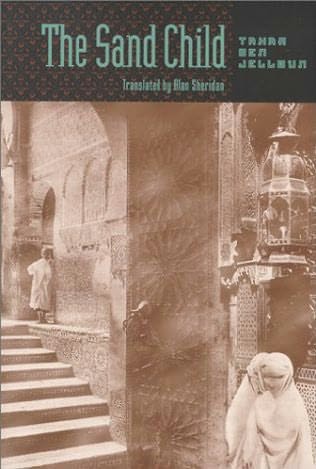
10. "The Sand Child" by Tahar Ben Jelloun


I apologize for not posting in a very long while. I've been off taking care of summery things. I plan on posting much more now that things have sort of settle and I'm getting "back into the game" so to speak. Anyway, here it is:

Ben Jelloun, Tahar. The Sand Child. Baltimore: The Johns Hopkins UP, 1985.
Reviewed by J. d’Artagnan Love

The storyteller in The Sand Child states, “When I read a book, I settle in it” (135). This was my experience as I read through The Sand Child. Set in Morrocco, The Sand Child is a prequel to The Sacred Night and starts at the very beginning of a complicated tale. Ahmed who later becomes Zahra is born female but raised as a male because of zir father’s obsession with having an heir. According to Islamic inheritance laws, only a son can inherit the full fortune of a family’s wealth.

From Ahmed/Zahra’s birth the prose is complicated and mythical. It is required that one “settles into it” to really absorb its worth. Deep and abstract, the text uses little dialogue and shifts between narrators frequently. It is as much about the protagonist as it is about the influence of storytelling in North Africa.

Having also read The Sacred Night I was pleasantly surprised at Jelloun’s ability to graceful move between narrative voices. Each storyteller has a vivid and distinct style. Readers are offered three possible endings to this portion of Ahmed/Zahra’s life. In creating a sort of choose-your-own-ending novel, Jelloun has given readers some control over their reading experience. The readers themselves can become storytellers too.

3.5 darts out of 5

Sunday, April 19, 2009

9. "Oranges Are Not the Only Fruit" by Jeanette Winterson


Winterson, Jeanette. Oranges are Not the Only Fruit. New York: Grove Press, 1985.
Reviewed by J. d’Artagnan Love

The color orange is supposed to represent energy and warmth but it is a far cry from what the protagonist experiences in Winterson’s first novel, Oranges are Not the Only Fruit. Raised in a Pentecostal church, Jeanette experiences extreme ridicule and humiliation after she is discovered to be in a romantic partnership with another woman. She is publicly humiliated in church causing her great emotional strife.

This is a difficult review to write after only reading the book once. There are many, many layers in this text that I certainly did not discover after just one pass through. One section of the text is a mythical fairy tale which emphasizes the importance of story-telling in the text. It wasn’t apparent to me at first, but the more I read the more I picked up on the numerous strands of stories that were being woven together.

Winterson writes, “Of course that is not the whole story, but that is the way with stories; we make them what we will. It’s a way of explaining the universe while leaving the universe unexplained, it’s a way of keeping it all alive, not boxing it into time” (93). This is a good way to interpret this work. It explains everything while leaving everything unexplained. Certainly worth reading a couple of times.

3.5 darts out of 5

Sunday, February 22, 2009

8. "Queer Theory and Social Change" by Max H. Kirsch


Kirsch, Max H. Queer Theory and Social Change. London: Routledge, 2000.
Reviewed by J. d’Artagnan Love

Queer Theory and Social Change was one of those life-changing books for me. I tend to be a pragmatic and practical person. I get more satisfaction from actively doing things and I enjoy being productive. This book gave me a new outlet for my work—a way to both think and do.

Kirsch is highly critical of queer theory but makes a clear distinction between queer theory and queer politics. He defines queer politics as a positive social movement. Queer politics allows for recognition of queer identity and the use of queer as a sort of umbrella under which LGBTI individuals can unite and form solidarity. Queer politics are active and productive. Kirsch defines queer theory as a theory of non-identity. He makes a parallel between queer theory and capitalism because of queer theory’s individualistic and apathetic nature. He claims that queer theory only reaffirms capitalist goals rather than dismantling capitalism like it claims to. Capitalism is reaffirmed because of the way queer theory doesn’t allow for community.

Kirsch is highly critical of Judith Butler and I must say he makes a few excellent points. He breaks down her work even to the particulars of her writing style. He argues that queer theory, Butler’s work in particular, needs to find a way to reconcile the individual vs. the community otherwise it is doing more damage to the queer movement than good. He writes about queer theory being the new “novelty” in academia when really, capitalism has already told the same stories.

This book is written in an easy-to-read prose. He uses solid evidence and whenever he presents a dense quote, he unpacks it so that readers are sure to understand. This is part of why I love this book. Hopefully, when I further my career in academia and am writing about densely theoretical work, I can do as a good a job as Kirsch does in making my work clear and easily understood. His logic is sound and he not only picks apart some of the problems of queer theory but offers some solutions as well. This book is certainly worth the read for anyone frustrated with queer theory but still wishing to embrace queer politics.

5 darts out of 5

Sunday, February 15, 2009

7. "Zami: A New Spelling of My Name" by Audre Lorde


Lorde, Audre. Zami: A New Spelling of My Name. Freedom: The Crossing Press, 1982.

Reviewed by J. d’Artagnan Love

Zami: A New Spelling of My Name is described as a “biomythography.” It traces the pain and also the joy that Audre Lorde experienced growing up in New York, working in Connecticut and studying in Mexico. It also traces the joys and sorrows accompanied with coming out and living as an “out” lesbian in the late 1940’s and early 1950’s. This book closely resembles work of other queer writers such as Leslie Feinberg. The struggles the women went through are similar and are documented in a similar way. Lorde is an advocate for community building, especially building communities of lesbians and other identified queer women. By structuring her book in the way she has, Lorde has joined the current community of queer literature and writers meeting her goal of community building in a very tangible way. In the course of the novel as well, she pays tribute to the many and varied women who have shaped her life.

“Being women together was not enough. We were different. Being gay-girls together was not enough. We were different. Being Black together was not enough. We were different. Being Black dykes together was not enough. We were different” (Lorde 226). Here Lorde ruminates on the different oppressions she, as a Black lesbian was faced with throughout her life. The book clearly and elegantly articulates the intricacies of this particular kind of oppression during the time of her youth.

Zami is a must for anyone interested in queer or multicultural literature. Lorde mixes her prose with her poetry and even uses meta-commentary at times. She takes a few lines to write about one character’s reaction when they learn that Audre is writing Zami. This creates a profound sense of awareness. Readers understand that Audre Lorde doesn’t mince words; each has its place just as, “The important message seemed to be that you had to have a place. Whether or not it did justice to whatever you felt you were about, there had to be some place to refuel and check your flaps” (Lorde 225). For Lorde, the place to refuel was found in the love she shared with the women in her life.

4.5 darts out of 5