Tuesday, December 29, 2009

15. "Ceremony" by Leslie Marmon Silko


Silko, Leslie Marmon. Ceremony. 1977. New York: Penguin Books, 2006.
244 pages
Reviewed by J. d’Artagnan Love

Ceremony by Leslie Marmon Silko documents the life of Tayo, a veteran of the Vietnam War. Tayo, who lives on a Native American settlement, suffers from severe shell-shock. In order to heal, he must complete a ceremony initiated by Betonie, one of the medicine men of his settlement.

Betonie begins the ceremony and it is up to Tayo to finish it. Interestingly enough, in the introduction to the book, Silko writes about how the writing of this book was her own healing ceremony. At the time that she began writing Ceremony, Silko was suffering from depression and homesickness. She and her family had moved far from her home and she was having a difficult time adjusting to the change. Silko suffered physically from depression with headaches and fatigue. By writing the novel, Silko was able to heal herself emotionally, and physically.

I have a deep love and appreciation for this novel. I was fortunate enough to read it at a time in my life when I was in need of healing myself. I found solace in Silko’s narrative, plot, imagery, characters, and poetry.

This novel is truly a masterpiece (and I’m not just saying that because of my own attachment to the characters and story). Silko weaves poetry into her prose and makes the theme of hybridity quite visible. Often, the poems take the shape of their subject—a poem about warriors is shaped like a downward pointing arrowhead, for example.

The plot is thickly layered and nonlinear. It holds readers’ attention and all the pieces come together quite nicely by the end.

Ceremony’s characters are deep and unique. I couldn’t help but feel compassion for all of them, even the antagonist(s). This is one of Silko’s gifts to her readers. She drives home the point that we are all connected, we are all imperfect, and our choices affect everyone. She humanizes the antagonists to break down the wall between “us” (the supposedly “good”) and “them” (the supposedly “evil”).

As I said in my last post, these reviews are not meant to judge those of you reading them. They are simply a way for me to express what value the books I read hold for me. In this case, Ceremony holds immeasurable value.

5 darts out of 5
Bookshelf Project Status: KEEP

Friday, November 13, 2009

14. A Note from d'Artagnan "On Elitism"

"On Elitism"

I am not going to post a book review as scheduled this week because the past couple of weeks have been insane and I just didn’t get to it. I will though, offer some thoughts on art, music, and literature and my book reviews in general.

Elitism in the creative arts pisses me off. I really can’t stand it when people confuse preference with status. I see and hear it happening a lot in my line of work. If Person A prefers a certain genre of music but Person B prefers an entirely different genre, Person A seems to automatically judge Person B. Suddenly Person B’s self-worth is mixed in with what music they listen to and whether or not that music is “cool” or “lame” according to Person A.

The same thing happens with literature. Certain books are devalued and therefore, anyone who likes those books are devalued as people. Preference or taste becomes a status game.

I HATE THIS CRAP. (Excuse my language.) I find it absolutely ridiculous.

It is my understanding that one of the main purposes of art, music, and literature, is to reach people. The creative arts are a means of self expression and connection. Just because a piece isn’t preferred by one person, doesn’t mean it can’t hold value to someone else. Just because Person A values a certain type of music, doesn’t make Person A somehow superior to Person B.

It is a matter of SUBJECTIVE PREFERENCE. One is not better than the other; they’re just different!!!

Reasons for connecting to or enjoying a song or a book or a painting are different for every single person. Maybe they like the lyrics to one song. Maybe a certain character reminds them of someone they loved. Maybe a brushstroke reminds them of who the hell knows what else.

My point is, people should be able to like the music, literature, and art of their choosing without that preference leading to some sort of judgment of their character, intelligence, or worth. The creative arts are meant to be enjoyed and discussed. They’re meant to be provocative and being elitist about any art form defeats its purpose entirely.

I hope that my reviews are not perceived as elitist.

Anything I express in this blog is ALWAYS up for discussion, contradiction, etc. I don’t claim to be the ultimate judge of ANYONE’S writing. In doing these reviews, I am not passing judgment on readers but expressing what value the books I read hold for me. Feel free to disagree as much as you would like. There is a good chance you’ll be right because I think that, ultimately, the only person that can truly judge the quality of a piece is YOU.

Ok, I’m done now. Hopefully I’ll have the Ceremony review up for you next week.

d’Artagnan

Wednesday, October 28, 2009

13. "Life of Pi" by Yann Martel


Martel, Yann. Life of Pi. Orlando: Harcourt Inc, 2001.
319 pages.
Reviewed by J. d’Artagnan Love

“This book was born as I was hungry,” writes Yann Martel of his novel, Life of Pi. Hunger is only one of the many sensations the protagonist experiences after he is shipwrecked in the Pacific. Life of Pi won the Man Booker Prize for fiction in 2002. Film director Ang Lee is also reported to be interested in directing a film adaptation due for release sometime in the year 2011. (This is according to his comments at the 2009 Cannes Film Festival).

In Life of Pi, Piscine Molitar Patel, known to world as Pi Patel, spends his childhood in Pondicherry, India. He grows up in a public zoo surrounded by exotic animals thanks to his father’s work as a zookeeper.

Pi, as a child, is passionate about God and religion. He is a Hindu, a Muslim, and a Christian all in one package. He finds God in everything—in the animals he tends to in the zoo, in the wind, in each of his places of worship, in his relationships. In the first part of the novel, he is truly saturated in a desire to know God and the nature of universe.

In Part Two of Life of Pi, Pi and his family have been hit with hard economic times. They decide to move to Canada where they plan to start a new life. The ship intended to take them to their new life in Canada unexpectedly sinks in the Pacific Ocean. Pi is stranded on a lifeboat with an orangutan, a Bengal tiger, an injured zebra, and an assortment of “pests”—rats, flies, etc.

Pi tells an incredible story of survival and faith. He managers to keep himself and Richard Parker (the tiger), alive through many different resourceful means from catching fish and turtles, to training the tiger like a circus performer, and finally, to discovering a mysterious floating island. He survives at sea for 227 days.

This text takes the reader to the brink of survival. The middle section becomes long and is filled with intricate details. It feels like the middle section will never come to an end, giving readers a taste of the desperation Pi, himself, might have felt during his ordeal.

Written to appear as nonfiction, the story becomes addicting. The characters are vivid, lovable, and real. Readers travel with Pi, cry with him, are afraid with him, become desperate with him.

The way the novel ends tests readers' faith on many levels. The ending’s twist makes readers question the difference between truth and fiction. Life of Pi will leave a lasting impression on all who are willing to join Pi on his journey.

3 darts out of 5

Monday, September 14, 2009

12. "Between the Acts" by Virginia Woolf


Woolf, Virginia. Between the Acts. San Diego: Harcourt Inc., 1941.
219 pages
Reviewed by J. d’Artagnan Love

Between the Acts
was the last book Virginia Woolf wrote before her suicide in 1941. It is a story about a family in England who hosts a play at their country home to raise money for the church. The plot covers the play itself as well as the interactions and happenings, as the title suggests, between the acts. There are several unhappy characters making connections with other equally unhappy characters and a lot of implied scandal that never comes to fruition.

I am usually a huge Virginia Woolf fan. She is my favorite writer, and this is the first of her novels that I’ve been disappointed by. Keeping in mind that she died before she was able to make revisions, the characters seemed to lack the motivation and depth Woolf had so frequently achieved in her earlier novels. The plot moved slowly, very slowly, and nothing really seemed to happen. The depiction of character interactions was dull and simplistic.

Maybe this is the effect Woolf was going for. Maybe she wished to illustrate how mundane life can be. If that was the goal, it sure didn’t make for good reading. This is not her best work and I would recommend Orlando or Mrs. Dalloway over Between the Acts in a heartbeat.

1.5 darts out of 5

Friday, August 28, 2009

11. "HOWL and Other Poems" by Allen Ginsberg


Ginsberg, Allen. HOWL and Other Poems. San Francisco: City Lights Books, 1956.
44 pages.
Reviewed by J. d’Artagnan Love

HOWL is the first book of poetry I’ve ever tried reviewing. This collection contains work by Ginsberg while he was in Berkeley, California and some from his earlier years as well. Originally meant as performance pieces, his poems explore themes of nature, love, God, spirituality, sex and sexuality, industrialism, materialism, and politics. HOWL’s publisher was actually put on “obscenity” trial because of the text’s graphic nature.

His poems are written in a Walt Whitman-esque style and in the poem “A Supermarket in California”, Ginsberg actually addresses Whitman directly. It is quite obvious that he was inspired by Whitman’s long and repetitive phrases. If you are a Walt Whitman fan, you will probably be able to appreciate this text.

My personal favorite poem from this collection was “America.” In “America” Ginsberg’s voice drips with ironic sadness, disappointment, and confusion. There is a certain intimacy about it that I greatly appreciated.

This text is worth a read if you are at all interested in poetry or queer writing and writers. He celebrates bodies and sex as something holy and doesn’t shy away from the darker parts of life in America in the 1950’s.

3 darts out of 5.

Saturday, July 18, 2009

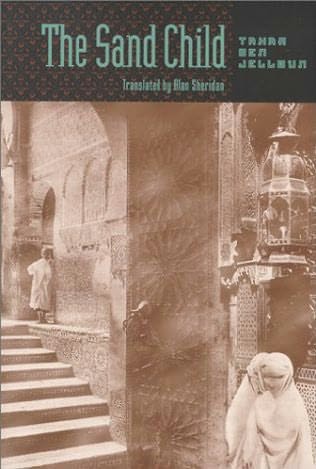
10. "The Sand Child" by Tahar Ben Jelloun


I apologize for not posting in a very long while. I've been off taking care of summery things. I plan on posting much more now that things have sort of settle and I'm getting "back into the game" so to speak. Anyway, here it is:

Ben Jelloun, Tahar. The Sand Child. Baltimore: The Johns Hopkins UP, 1985.
Reviewed by J. d’Artagnan Love

The storyteller in The Sand Child states, “When I read a book, I settle in it” (135). This was my experience as I read through The Sand Child. Set in Morrocco, The Sand Child is a prequel to The Sacred Night and starts at the very beginning of a complicated tale. Ahmed who later becomes Zahra is born female but raised as a male because of zir father’s obsession with having an heir. According to Islamic inheritance laws, only a son can inherit the full fortune of a family’s wealth.

From Ahmed/Zahra’s birth the prose is complicated and mythical. It is required that one “settles into it” to really absorb its worth. Deep and abstract, the text uses little dialogue and shifts between narrators frequently. It is as much about the protagonist as it is about the influence of storytelling in North Africa.

Having also read The Sacred Night I was pleasantly surprised at Jelloun’s ability to graceful move between narrative voices. Each storyteller has a vivid and distinct style. Readers are offered three possible endings to this portion of Ahmed/Zahra’s life. In creating a sort of choose-your-own-ending novel, Jelloun has given readers some control over their reading experience. The readers themselves can become storytellers too.

3.5 darts out of 5

Sunday, April 19, 2009

9. "Oranges Are Not the Only Fruit" by Jeanette Winterson


Winterson, Jeanette. Oranges are Not the Only Fruit. New York: Grove Press, 1985.
Reviewed by J. d’Artagnan Love

The color orange is supposed to represent energy and warmth but it is a far cry from what the protagonist experiences in Winterson’s first novel, Oranges are Not the Only Fruit. Raised in a Pentecostal church, Jeanette experiences extreme ridicule and humiliation after she is discovered to be in a romantic partnership with another woman. She is publicly humiliated in church causing her great emotional strife.

This is a difficult review to write after only reading the book once. There are many, many layers in this text that I certainly did not discover after just one pass through. One section of the text is a mythical fairy tale which emphasizes the importance of story-telling in the text. It wasn’t apparent to me at first, but the more I read the more I picked up on the numerous strands of stories that were being woven together.

Winterson writes, “Of course that is not the whole story, but that is the way with stories; we make them what we will. It’s a way of explaining the universe while leaving the universe unexplained, it’s a way of keeping it all alive, not boxing it into time” (93). This is a good way to interpret this work. It explains everything while leaving everything unexplained. Certainly worth reading a couple of times.

3.5 darts out of 5