Sunday, July 11, 2010

21. "Beneath the Wheel" by Herman Hesse


Hesse, Herman. Beneath the Wheel. New York: Farrar, Strous, and Giroux, 1968.
Translated by Michael Roloff
187 pages

Reviewed by J. d’Artagnan Love

The first book I read by Herman Hesse was Siddhartha. I read that book when I was sixteen and it changed my life. Beneath the Wheel hasn’t been as life-altering, but it is a novel that has an uncanny parallel to some of the decisions I’m making and issues I’m struggling with in my own life. Herman you rascal, you’ve done it again.

Herman Hesse (1877-1962) was a novelist, a poet, and a painter. Originally from Germany, his work frequently explores an individual’s search for self-knowledge, authenticity, and spirituality. He struggled with depression most of his life which he illustrates in Beneath the Wheel.

Beneath the Wheel was Hesse’s second novel and was originally published in 1906. It closely parallels parts of Hesse’s own life, making it a semi-autobiographical work. The novel is about Hans Giebenrath, a young, and vastly intelligent man. The story begins with Hans in the thick of studying for an important state examination. He feels pressure from every part of his community save one—Flaig, the shoemaker. When asked about Hans the school principle states, “Just look at him. He’s the veritable incarnation of intellect” (Hesse 8).

Hesse creates a contrast between academia and creativity. For the sake of the novel, academia seems to represent logic, intellect, ambition, and discipline to the detriment of creativity, spirituality, emotion, and instinct. The biggest struggle Hans deals with is learning to balance all of these parts of himself in a way that will make him happy. Pressured by friends, teachers, and his father, he suffers from constant headaches and various other health issues.

At the Maulbronn Academy, Hans meets Herman Heilner, a sensitive, and creative boy. Heilner is described as a genius who resists all of the academy’s attempts at molding the young man. Constantly in trouble with the Headmaster, Heilner’s creativity flourishes despite the school’s attempts to squelch it. Hesse writes,

“Teachers dread nothing so much as unusual characteristics in precocious boys during the initial stages of adolescence. A certain streak of genius makes an ominous impression on them, for there exists a deep gulf between genius and the teaching profession. . . . A schoolmaster will prefer to have a couple of dumbheads in his class than a single genius, and if you regard it objectively, he is of course right. His task is not to produce extravagant intellects but good Latinists, arithmeticians and sober decent folk. The question of who suffers more acutely at the other’s hands—the teacher at the boys, or vice versa—who is more of a tyrant, more of a tormentor, and who profanes parts of the other’s soul, student or teacher, is something you cannot examine without remembering your own youth in anger and shame” (99-100).

Heilner is expelled leaving Hans friendless and alone at the academy with no emotional outlet or social support--not even from his teachers.

Beneath the Wheel is an exploration of humans’ duality. Hans craves the solitude of being in nature and going fishing but another part of him thirsts for knowledge and finds great pride in his academic success. The novel explores Hans’ attempts at balancing his life’s ambitions which is something I am grappling with in my own life right now. Academia consumes lives. It is highly competitive, highly demanding, and not very nurturing as is seen in the examples of Hans’ experiences at the Maulbronn Academy. You either keep up with the pack or are crushed beneath the wheel.

4.5 darts out of 5
Bookshelf Project Status: KEEP

Sunday, June 27, 2010

20. June 2010 List

The following is a list of all the books I read in June 2010. There are a lot as I was finishing up my thesis. Many of the books I re-read in preparation for my thesis defense. I did book reviews for some of them (which will be noted in the list) and the rest I did not. If there is a book on this list that I did not review but that interests you, I will do a review upon request.

To send in requests for reviews email me the title of the text you want reviewed to: j.dartagnan.love@gmail.com

Make sure your subject line says "Book Review Request" so that I don't send it to my junk mail folder.

I can not guarantee when the review will be posted but I will write one up eventually. :) Here's the list for June:

1. Feinberg, Leslie. Stone Butch Blues. Los Angeles: Alyson Books, 1993. Print.

2. Kirsch, Max H. Queer Theory and Social Change. London: Routledge, 2000. Print.

3. Larson, Jonathan. RENT. New York: William Morrow & Company Inc., 1997. Print.

4. McKruer, Robert. The Queer Renaissance: Contemporary American Literature and the Reinvention of Lesbian and Gay Identities. New York: New York UP, 1997. Print.

5. Merry, Sally Engle. Human Rights and Gender Violence: Translating International Law into Local Justice. Chicago: University of Chicago Press, 2006. Print.

6. Ohba, Tsugumi and Takeshi Obata Death Note. San Francisco: Shonen Jump, 2003. Print. 12 Volumes. Reviewed 6-8-10

7.Prosser, Jay. Second Skins: The Body Narratives of Transexuality. New York: Columbia UP, 1998. Print.

8. Sedgwick, Eve Kosofsky. Epistemology of the Closet. Berkeley: University of California Press, 1990. Print. Reviewed in 2009.

9. Saxey, Esther. Homoplot: The Coming-Out Story and Gay, Lesbian and Bisexual Identity. New York: Peter Lang, 2008. Print.

10. Sinfield, Alan. Cultural Politics-Queer Reading. Philadelphia: University of Pennsylvania Press, 1994. Print.

11. Slaughter, Joseph. Human Rights Inc.: The World Novel, Narrative Form, and International Law. New York: Fordham UP, 2007. Print.

12. Wronka, Joseph. Human Rights and Social Policy in the 21st Century. New York: University Press of America, 1998. Print.

Tuesday, June 8, 2010

19. "Death Note" by Tsugumi Ohba and Takeshi Obata


Ohba, Tsugumi and Takeshi Obata. Death Note. San Francisco: Shonen Jump, 2003. Print
12 Volumes
Reviewed by J. d’Artagnan Love

I originally became interested in this series because a friend of mine recommended the anime version to me. I watched the anime up to a certain point, and then when I lost my internet, I started reading the manga series.

Death Note
is about a notebook, a very deadly notebook. In fact, whenever a name is written in the notebook that person dies of heart attack shortly after the name is written (unless a specific time and mode of death is written).

The notebook belongs in the Shinigami realm, or, the realm of the gods of death. When a Shinigami gets bored, he decides to drop his notebook to earth and see what happens. A teenager named Light Yagami finds the notebook. Once he learns of the notebook’s powers, he decides to become the new justice system for planet earth. He kills anyone who commits a heinous crime, but eventually, Light gets drunk on power and begins to venture outside just criminals.

The story spirals out of control much in the way Light does. The problem grows bigger and bigger and eventually ends up on the world stage when Light takes political control of the world.

This series is so complicated and layered. Generally, it is a fast-paced read with the exception of a few lulls here and there. The characters are very well developed and the art is great. I’m no expert on film analysis or art, but the graphics in this series are creative and thought provoking, adding a new layer to the already complex narrative.

While I loved almost all of this series there was one thing that bothered me: the representation of women. There were very few female characters in this twelve volume set. The few women characters that were included were objectified as sexual objects, dumbed down, and used as dispensable plot devices. While this series isn’t nearly as terrible as other manga I’ve seen in terms of its representations of female characters, it still does no justice to women.

Aside from that though, there is little that I didn’t like about this series.

3.5 darts out of 5
Bookshelf Project Status: NONE (I don't own them.)

Monday, May 31, 2010

18. "Blessed Unrest" by Paul Hawken


Hawken, Paul. Blessed Unrest. New York: Viking, 2007. Print.
Reviewed by J. d’Artagnan Love

Paul Hawken, an environmentalist and writer, toured the country for years giving lectures. Over the years, he collected numerous business cards from people involved in various activist groups—typically social, economic, and environmental justice organizations. He became curious about the sheer number of cards he had stored up over the years and began to count them. This lead to an even greater curiosity. How many justice organizations are there? Hawken has counted over two million activist groups around the world working towards various forms of social, economic and environmental justice.

Hawken calls activism in the 21st century, “the largest movement in the world” (5). He writes that what is happening with activism in the world today can be considered the largest and most important social movement in recorded history. He notes that “The Movement” started during the abolition. The abolition illustrates the first time in recorded history that people have come together to work for the good of people they have never met, and will never meet; they are simply doing it because it is the right thing to do (Hawken 5). He writes:

“The [. . .] individuals who may never meet and come to know one another are part of a coalescence comprising hundreds of thousands of organizations. It claims no special power and arises in small, discrete ways, like blades of grass after a rain. The movement grows and spreads in every city and country and involves virtually every tribe, culture, language, and religion. [. . .]
The movement can’t be divide because it is so atomized—a collection of small pieces, loosely joined” (11).

Hawken traces the environmental movement back to its roots and he argues that it is important not to separate human beings from nature. He writes that we are nature and therefore, social justice movements are also environmental movements and vice versa.

He points out the importance of preserving indigenous culture so that we might learn from them—not in an overly romanticized way but in a practical way. He goes on to write about concentrations of wealth and issues with trade and globalization.

Toward the end of the book he writes about the earth being its own living organism. He then compares The Movement to our own bodies’ immune systems. He writes that The Movement acts as an immune system for the earth.

In all, I really liked this book. My biggest point of criticism lies in a slight lack of cohesion. Certain points that were made didn’t automatically appear to support the larger argument. At times, I really had to work to understand how certain examples and illustrations were proving the point and supporting the argument. The connections were not made automatically clear; I had to infer them.

This worked fine for me as I have already had some experience working in and reading about the kinds of campaigns and information that Hawken presents, but I do think for someone who might not have this same experience, the connections may be impossible to make. The writing style itself is very clear, but I wanted more explicit connections between the support and the overall argument.

3.5 darts out of 5
Bookshelf Project Status: NONE; I don't own it.

Sunday, April 25, 2010

17. The Bookshelf Project

So, for this blog I am starting a new project I like to call "The Bookshelf Project." I am "weeding" my bookshelf. I have too many books. Yes, I said it. TOO MANY. My books overflow my bookshelves onto mountainous piles on my floor and other parts of my home.

Call me a simpleton, but I don't plan on ever living in a space much bigger than the one I'm living in now. Maybe slightly, but not much. What I have now, will be what I have then, if that makes any sense. I don't NEED a space bigger than this. The size of my current living situation is highly satisfying. A spacious one-bedroom apartment (Proabaly between 1,000 and 1,200 square feet of space). This place is LUXURIOUS in comparison to other places I've lived and also in comparison to spaces that most people around the world occupy. I refuse to rent or buy a larger living space to satisfactorily store all of my accumulated "stuff." So, the "stuff" has got to go.

My library is one place I could definitely downgrade. Holding a random book in my hand I ask myself: Could I find this book easily at a library? Yes? Then, it's got to go. Donate it to a library, to a school, to Goodwill--wherever! It has to go nonetheless.

I have a large amount of books in my library that I haven't read or haven't read all the way through. So, "The Bookshelf Project" involves reading and rereading the books in my library. I plan to only keep books that are hard to find (i.e. can't be found at a public library), and books that I love and will read over and over again.

So far from my collection I have read:
"Ceremony" by Leslie Marmon Silko
"Emma" by Jane Austen

"Ceremony" was a keeper; "Emma" had to go. I sent it off to Goodwill. I'm sure some poor teenager/college student is going to be required to read that and will be happy to purchase it for $.25 at Goodwill rather than $20 at the bookstore.

So, if you notice, on my reviews I have added a section under the rating that indicates whether the book was a "keep" or a "donate". I will continue this process until I've made it through every book on my shelf...and floor, and desk, and coffee table. Yep, I've got a lot of reading to do!

Saturday, March 27, 2010

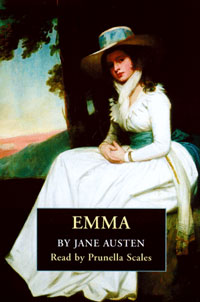
16. "Emma" by Jane Austen


Austen, Jane. Emma. New York: Washington Square Press, 1963.
430 pages
Reviewed by J. d'Artagnan Love

Since I started studying literature, I have begun to read in a very calculating way. I read looking for certain things like theme, feminist and queer discourse, post-colonial rhetoric, tropes, plot devices, errors, holes, flat characters, etc. I can’t remember the last time I just read a book forgetting about all these very academic forms of reading. Studying literature has certainly added a new dimension of thought to my reading but it has sucked the life out of the characters for me in some ways. No longer are they there for me to feel connected to, but for me to pick apart and analyze.

I started reading Emma over a year ago and, at first I thought it was this exact form of calculated reading that has kept me at a distance from this novel’s characters. For the first half of the book or so, all I could think about was how boring they were—rich, British snobs sitting around doing nothing but gossip about each other. To me, they held little depth and caused each other nothing but trouble.

So, I tried to put aside my literary “training” and just read the novel for pleasure. I tried to get to know the characters, to become involved in the plot.

It didn’t work.

As much as my academic peers will give me crap for it, I don’t like this book and I couldn’t finish it. It was a little bit like literary torture trying to read to the end. I stopped at 2/3’s of the way through. I could go no farther.

I am a very plot-oriented reader. I like a good story. Emma’s plot bored me. The characters gossip from one party to the next and poor widdle Emma meddles needlessly and unproductively in other people’s lives. Maybe I would gain a better appreciation of the book if I read it through to the end. Maybe there is some mind-blowing plot twist on page 400 that I’ve missed. The thought still wasn’t enough to get me to keep reading.

1 dart out of 5
Bookshelf Project Status: DONATE (donated to Goodwill)

Tuesday, December 29, 2009

15. "Ceremony" by Leslie Marmon Silko


Silko, Leslie Marmon. Ceremony. 1977. New York: Penguin Books, 2006.
244 pages
Reviewed by J. d’Artagnan Love

Ceremony by Leslie Marmon Silko documents the life of Tayo, a veteran of the Vietnam War. Tayo, who lives on a Native American settlement, suffers from severe shell-shock. In order to heal, he must complete a ceremony initiated by Betonie, one of the medicine men of his settlement.

Betonie begins the ceremony and it is up to Tayo to finish it. Interestingly enough, in the introduction to the book, Silko writes about how the writing of this book was her own healing ceremony. At the time that she began writing Ceremony, Silko was suffering from depression and homesickness. She and her family had moved far from her home and she was having a difficult time adjusting to the change. Silko suffered physically from depression with headaches and fatigue. By writing the novel, Silko was able to heal herself emotionally, and physically.

I have a deep love and appreciation for this novel. I was fortunate enough to read it at a time in my life when I was in need of healing myself. I found solace in Silko’s narrative, plot, imagery, characters, and poetry.

This novel is truly a masterpiece (and I’m not just saying that because of my own attachment to the characters and story). Silko weaves poetry into her prose and makes the theme of hybridity quite visible. Often, the poems take the shape of their subject—a poem about warriors is shaped like a downward pointing arrowhead, for example.

The plot is thickly layered and nonlinear. It holds readers’ attention and all the pieces come together quite nicely by the end.

Ceremony’s characters are deep and unique. I couldn’t help but feel compassion for all of them, even the antagonist(s). This is one of Silko’s gifts to her readers. She drives home the point that we are all connected, we are all imperfect, and our choices affect everyone. She humanizes the antagonists to break down the wall between “us” (the supposedly “good”) and “them” (the supposedly “evil”).

As I said in my last post, these reviews are not meant to judge those of you reading them. They are simply a way for me to express what value the books I read hold for me. In this case, Ceremony holds immeasurable value.

5 darts out of 5
Bookshelf Project Status: KEEP