Showing posts with label Queer Literature. Show all posts

Friday, April 3, 2020

137. My Gender Workbook by Kate Bornstein


Bornstein, Kate. My Gender Workbook. New York, NY: Routledge, 1998. Print.

292 pages

Reviewed by Jess d'Artagnan Love

In Kate Bornstein’s My Gender Workbook, the author’s goal is to help readers discover their own gender identity. The book includes journal prompts along with an in-depth discussion of what gender is, and what it means in a larger societal context. Bornstein provides several different models of gender that address the intersecting concepts of gender, power, and sexuality.

I thought the more academic part of the workbook was well done. It was thorough, thoughtful, and based on sound academic research on gender and what it means to have a gender identity.

The workbook part of the book was clearly biased toward readers choosing to not identify as any gender at all. The journal prompts and questions in the quizzes were leading and lead readers toward agender or non-binary identity. They almost make someone feel guilty for choosing a more stereotypical gender identity and make the claim that those who want to maintain a more common cultural construct of gender is misinformed and naive about gender. I don’t agree with that position. I hold the position that all gender identities are good identities whether they are non-traditional or not.

Aside from the obvious bias toward agender/nonbinary identity, the book was an interesting and though-provoking read and I enjoyed it.

Would I read it again? 
Yes, I think this is a book that I will continue to learn and be inspired from the more I read it.

Recommended for
Those interested in gender identity politics and gender studies.

Not Recommended for
Readers under the age of 15, mostly because some of the content may be hard for them to comprehend.

Word Bank
·         None


3 stars out of 5

Kate Bronstein’s Website: http://katebornstein.com/


Connect with me!


Sunday, July 1, 2012

57. "The Absolutist" by John Boyne


Boyne, John. The Absolutist. New York: Doubleday, 2012.

320 pages

Reviewed by J. d’Artagnan Love

John Boyne is an Irish writer most known for his novel The Boy in the Striped Pyjamas. The Boy in the Striped Pyjamas has sold over 5 million copies and was recently made into a major motion picture. His work has been published in over forty different languages and The Absolutist is his most recent novel.

Set during the first World War, The Absolutist follows seventeen-year-old Tristan Sadler as he lies about his age, enlists in a British regiment, and is sent to the trenches. During basic training at Aldershot, Tristan meets Will, a curious and moral soldier who swiftly entrances Tristan with his depth and physical beauty. Their relationship is not a simple story. It is fraught with confusion, anger, pain, passion, and questioning.

In the trenches they must wrestle with big questions. What is a human life worth? Tristan often thinks about the humanity of the enemy soldiers pondering, “I crawl forward on my belly, holding my rifle before, my left eye firmly closed as I look down the viewfinder for anyone advancing in my direction. I picture myself locking eyes with a boy of my own age, both of us terrified, in the instant before we shoot each other dead” (Boyne). For Tristan, the Germans he is fighting and killing are people, young men just like him.

Will is the son of a vicar and has high moral standards, standards that are too high for the rest of his regiment. He follows in the footsteps of the conscientious objectors that came before him which causes the greatest divide between Will and Tristan. Is an idea or principle worth dying for? What is courage and how does one display it? These are all questions this novel explores in heartbreaking and sobering ways. Boyne does not beat around the bush when it comes to the harsh realities of love and war in 20th century England. By the end of the novel I was in tears.

The Absolutist is captivating. The nonlinear plot kept me riveted and wanting more. The characters possess depth and flaws and are extraordinarily human. Reminiscent of All Quiet on the Western Front, The Absolutist will take you into a world where simple pleasures are “the result of inhuman deprivations” and unconditional love is the greatest form of courage (Boyne).

 4.5 darts out of 5

Bookshelf Project Status: KEEP

Sunday, April 29, 2012

54. "Red Nails, Black Skates" by Erica Rand


Rand, Erica. Red Nails, Black Skates: Gender Cash and Pleasure on and off the Ice. Duke University Press, 2012

264 pages

In her study on figure skating, gender, class, race and risk, Erica Rand writes, “Do you know what can happen when you put knives on your feet and hurl yourself around backward into the air to land on the mere tip of just one of those blades? It’s called perilous, baby, and it’s a risk I choose every day” This is an apt way of exemplifying how Rand breaks stereotypes that envelope figure-skating in gender-based constructs. 

These constructs don’t fit into simple or stable categories. As Rand writes, “Nor do apparently simple categories always have simple criteria. What exactly, for instance, is that crazy combination of balletic aristocrat and child-beauty-pageant trampiness that characterizes many figure skating costumes for girls and women?” Rand’s exploration of skating outfits transcends just fashion talk and hits on tough topics like transgender identity and socially reinforced norms within the field of skating.

In Red Nails, Black Skates, Rand explores the intricate and interwoven roles of class, race, and gender among other hot topics such as sexuality, pleasure and risk. She goes beyond the figure skating world to also explore issues of gender and class in women’s hockey and the growing sport of roller derby.  At one point she spends time practicing with the women’s hockey team, noting her discomfort at the masculine uniforms that other hockey players thrived in.

Written in clear and accessible prose, Rand clearly outlines her purpose of the field research she participates in. The stories are exciting and enjoyable to read in themselves and Rand’s accompanying critical analysis sheds light on a corner of gender and sport ripe for further exploration.  

Rand explores her own transformation through skating writing, “It transformed my athletic life, my work life, my social life, and, less directly, my erotic life. It increasingly determined my longrange plans as well as my daily and weekly schedules, which I came to arrange around available ice time and other physical activities…” This personal disclosure helps readers connect with Rand beyond social criticism at a level that is both vulnerable and human. This well-rounded text is a fantastic read for anyone interested in gender and sports.

4 darts out of 5
Bookshelf Project Status: KEEP

Saturday, January 15, 2011

36. "Written on the Body" by Jeanette Winterson


Winterson, Jeanette. Written on the Body. New York: Vintage International, 1992. Print

190 pages

Reviewed by J. d’Artagnan Love

Written on the Body is an erotic tale of love, desire and loss. The protagonist moves from woman to woman, never really falling in love until she meets Louise. Louise has a secret that drives the protagonist to misery. Truthfully though, the protagonist causes her own misery. She is selfish to the end and by the time she learns her lesson, it is too late.

I love Jeanette Winterson’s writing style. It is fluid and abstract. The issue I had with this book, was I did not like the protagonist. This made it hard for me to like the book. I identified with Louise and ached for her. I related all too well with Jacqueline, one of the protagonist's many betrayed girlfriends, when she says to her, “You mean we’ll talk about it and you’ll do what you want anyway” (Winterson 58).

As hard as I tried, I could not sympathize with the main character and I could not, despite the beautiful, lyrical writing, enjoy the book very much.

2 darts out of 5

Bookshelf Project Status: Given as gift.

Friday, August 28, 2009

11. "HOWL and Other Poems" by Allen Ginsberg


Ginsberg, Allen. HOWL and Other Poems. San Francisco: City Lights Books, 1956.
44 pages.
Reviewed by J. d’Artagnan Love

HOWL is the first book of poetry I’ve ever tried reviewing. This collection contains work by Ginsberg while he was in Berkeley, California and some from his earlier years as well. Originally meant as performance pieces, his poems explore themes of nature, love, God, spirituality, sex and sexuality, industrialism, materialism, and politics. HOWL’s publisher was actually put on “obscenity” trial because of the text’s graphic nature.

His poems are written in a Walt Whitman-esque style and in the poem “A Supermarket in California”, Ginsberg actually addresses Whitman directly. It is quite obvious that he was inspired by Whitman’s long and repetitive phrases. If you are a Walt Whitman fan, you will probably be able to appreciate this text.

My personal favorite poem from this collection was “America.” In “America” Ginsberg’s voice drips with ironic sadness, disappointment, and confusion. There is a certain intimacy about it that I greatly appreciated.

This text is worth a read if you are at all interested in poetry or queer writing and writers. He celebrates bodies and sex as something holy and doesn’t shy away from the darker parts of life in America in the 1950’s.

3 darts out of 5.

Saturday, July 18, 2009

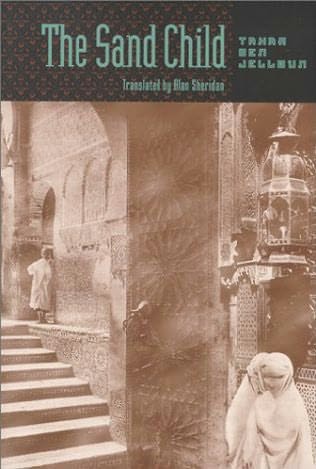
10. "The Sand Child" by Tahar Ben Jelloun


I apologize for not posting in a very long while. I've been off taking care of summery things. I plan on posting much more now that things have sort of settle and I'm getting "back into the game" so to speak. Anyway, here it is:

Ben Jelloun, Tahar. The Sand Child. Baltimore: The Johns Hopkins UP, 1985.
Reviewed by J. d’Artagnan Love

The storyteller in The Sand Child states, “When I read a book, I settle in it” (135). This was my experience as I read through The Sand Child. Set in Morrocco, The Sand Child is a prequel to The Sacred Night and starts at the very beginning of a complicated tale. Ahmed who later becomes Zahra is born female but raised as a male because of zir father’s obsession with having an heir. According to Islamic inheritance laws, only a son can inherit the full fortune of a family’s wealth.

From Ahmed/Zahra’s birth the prose is complicated and mythical. It is required that one “settles into it” to really absorb its worth. Deep and abstract, the text uses little dialogue and shifts between narrators frequently. It is as much about the protagonist as it is about the influence of storytelling in North Africa.

Having also read The Sacred Night I was pleasantly surprised at Jelloun’s ability to graceful move between narrative voices. Each storyteller has a vivid and distinct style. Readers are offered three possible endings to this portion of Ahmed/Zahra’s life. In creating a sort of choose-your-own-ending novel, Jelloun has given readers some control over their reading experience. The readers themselves can become storytellers too.

3.5 darts out of 5

Sunday, April 19, 2009

9. "Oranges Are Not the Only Fruit" by Jeanette Winterson


Winterson, Jeanette. Oranges are Not the Only Fruit. New York: Grove Press, 1985.
Reviewed by J. d’Artagnan Love

The color orange is supposed to represent energy and warmth but it is a far cry from what the protagonist experiences in Winterson’s first novel, Oranges are Not the Only Fruit. Raised in a Pentecostal church, Jeanette experiences extreme ridicule and humiliation after she is discovered to be in a romantic partnership with another woman. She is publicly humiliated in church causing her great emotional strife.

This is a difficult review to write after only reading the book once. There are many, many layers in this text that I certainly did not discover after just one pass through. One section of the text is a mythical fairy tale which emphasizes the importance of story-telling in the text. It wasn’t apparent to me at first, but the more I read the more I picked up on the numerous strands of stories that were being woven together.

Winterson writes, “Of course that is not the whole story, but that is the way with stories; we make them what we will. It’s a way of explaining the universe while leaving the universe unexplained, it’s a way of keeping it all alive, not boxing it into time” (93). This is a good way to interpret this work. It explains everything while leaving everything unexplained. Certainly worth reading a couple of times.

3.5 darts out of 5

Sunday, February 15, 2009

7. "Zami: A New Spelling of My Name" by Audre Lorde


Lorde, Audre. Zami: A New Spelling of My Name. Freedom: The Crossing Press, 1982.

Reviewed by J. d’Artagnan Love

Zami: A New Spelling of My Name is described as a “biomythography.” It traces the pain and also the joy that Audre Lorde experienced growing up in New York, working in Connecticut and studying in Mexico. It also traces the joys and sorrows accompanied with coming out and living as an “out” lesbian in the late 1940’s and early 1950’s. This book closely resembles work of other queer writers such as Leslie Feinberg. The struggles the women went through are similar and are documented in a similar way. Lorde is an advocate for community building, especially building communities of lesbians and other identified queer women. By structuring her book in the way she has, Lorde has joined the current community of queer literature and writers meeting her goal of community building in a very tangible way. In the course of the novel as well, she pays tribute to the many and varied women who have shaped her life.

“Being women together was not enough. We were different. Being gay-girls together was not enough. We were different. Being Black together was not enough. We were different. Being Black dykes together was not enough. We were different” (Lorde 226). Here Lorde ruminates on the different oppressions she, as a Black lesbian was faced with throughout her life. The book clearly and elegantly articulates the intricacies of this particular kind of oppression during the time of her youth.

Zami is a must for anyone interested in queer or multicultural literature. Lorde mixes her prose with her poetry and even uses meta-commentary at times. She takes a few lines to write about one character’s reaction when they learn that Audre is writing Zami. This creates a profound sense of awareness. Readers understand that Audre Lorde doesn’t mince words; each has its place just as, “The important message seemed to be that you had to have a place. Whether or not it did justice to whatever you felt you were about, there had to be some place to refuel and check your flaps” (Lorde 225). For Lorde, the place to refuel was found in the love she shared with the women in her life.

4.5 darts out of 5

Monday, February 2, 2009

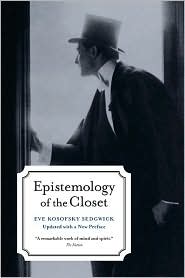
5. "Epistemology of the Closet" by Eve Kosofsky Sedgwick


Sedgwick, Eve Kosofsky. Epistemology of the Closet. 1990. Berkeley: University of California Press, 2008.

Reviewed by J. d’Artagnan Love

Eve Kosofsky Sedgwick is one of the most notable writers in her field. In my first try at reviewing a piece of literary criticism I’ve found myself staring at a blank computer screen for a long while now. Sedgwick’s writing is a dizzying maze of nominalizations. It took me several tries to unpack this sentence: “Instead, I am trying to make the strongest possible introductory case for a hypothesis about the centrality of this nominally marginal, conceptually intractable set of definitional issues to the important knowledges and understandings of twentieth-century Western culture as a whole” (Sedgwick 2). Eventually, I became accustomed to her prose and, with a decently thick dictionary by my side, I was able to enter Epistemology of the Closet and come out alive.

Sedgwick focuses on the idea of the “closet” and the function that the “closet” performs in literature. The “closet,” if I have translated Sedgwick’s work accurately, is a sort of axis of power in homosexual identification and rhetoric. You can be “in the closet;” what Sedgwick describes as “the viewpoint of the closet,” or you can be aware of someone who is “closeted;” the “spectacle of the closet”. The “closet” functions as an open-secret of sorts.

The primary texts that Sedgwick works to explicate are themselves, dense and theory-heavy. She covers writers such as Oscar Wilde, Proust, Nietzsche and Melville. Her analysis of each text is interesting and thought-provoking, although, at points, overwhelming. This work would be much better appreciated if one has already read work by Wilde, Proust, Nietzsche and Melville. I’ve got three of the four writers under my belt and found that fourth section more challenging than the rest simply due to my own lack of knowledge of that specific writer. Sedgwick has assumed that her audience is already familiar with these writers so if you plan on digging into this text, come to the table prepared.

Epistemology of the Closet is a very challenging read and it is one of those texts that, no matter how many times one reads it, one can pull out something new from it or understand a part more clearly. That is part of the beauty of this book. It gets better each time you read it. (Trust me, I’ve had to read it on more than one occasion). Her work, I must admit, is daunting and not exactly the most accessible piece of writing I’ve come across. She writes in an obviously academic style which isn’t inherently a bad thing but could certainly be discouraging (and annoying) for those looking for a quick read.

3 darts out of 5.

Saturday, January 31, 2009

4. "Middlesex" by Jeffrey Eugenides


Eugenides, Jeffrey. Middlesex. New York: Farrar, Straus and Giroux, 2002.
Reviewed by J. d’Artagnan Love

“I was born twice: first, as a baby girl, on a remarkably smogless Detroit day in January of 1960; and then, again, as a teenage boy, in an emergency room near Petosky, Michigan, in August of 1974” (Eugenides 3). This is the first sentence of Jeffrey Eugenides second novel, Middlesex. The novel won the Pulitzer Prize for Fiction in 2003 and certainly earned that title.

Eugenides weaves a beautiful and intricate story much like the silk worms he writes about. Middlesex is more than a story; it is a genealogy. Starting with Lefty and Desdemona, the plot unravels and knots and then untangles again in an enthralling circular narrative told by Cal, formerly Calliope. Cal was born Calliope and unbeknownst to him, is an intersexed individual; something he inherited from his Greek ancestry and long line of incestuous familial ties.

The plot starts with Lefty and Desdemona, Cal’s grandparents. They travel to America after their home in Bithynios is destroyed. The rest of the plot traces the genealogy of the Stephanides family and the defective gene that is passed down the family line.

Reading this book was like looking through a family scrapbook. Each character becomes so real and so dynamic one cringes with Cal/Calliope as s/he undergoes inspection by various doctors and researchers and one celebrates with Lefty and Desdemona when they survive the fires in Smyrna.

Eugenides has done his research as each chapter is full, not only of gut-wrenching character sketches and anecdotes, but rich histories. Three generations of the Stephanides family saw great changes in the world and Eugenides documents these changes and events in believable and lyrical ways. From violence between Greece and Turkey in the 1920’s, to Black Nationalism in Detroit, and the Gay Rights movement in San Francisco, Eugenides’s plot unwinds like a ball of yarn to create a something beautiful, mythical, believable and real.

4.5 darts out of 5.